← Back to Cohere videos ← Terug naar Cohere-video's
Cohere VIDEO VIDEO 27 March 2026 27 maart 2026
YouTube

In this presentation, we address domain adaptation in semantic segmentation, where deep learning models rely heavily on large labeled datasets and struggle with domain shift, limit...

Yasser Benigmin - Domain Adaptation in the Era of Foundation Models Yasser Benigmin - Domain Adaptation in the Era of Foundation Models

In this presentation, we address domain adaptation in semantic segmentation, where deep learning models rely heavily on large labeled datasets and struggle with domain shift, limiting real-world generalization. We show how Foundation Models... In this presentation, we address domain adaptation in semantic segmentation, where deep learning models rely heavily on large labeled datasets and struggle with domain shift, limiting real-world generalization. We show how Foundation Models...

Video details Videogegevens
AI maker AI-maker Cohere Published Gepubliceerd 27 March 2026 27 maart 2026 Channel Kanaal Cohere Playlist Playlist Uploads from Cohere Updates Updates Videos Video's Watch on YouTube Bekijk op YouTube

About this video Over deze video

In this presentation, we address domain adaptation in semantic segmentation, where deep learning models rely heavily on large labeled datasets and struggle with domain shift, limiting real-world generalization. We show how Foundation Models (FMs) can be adapted to overcome these challenges under resource constraints through three key contributions. First, we present DATUM, a one-shot unsupervised domain adaptation approach that personalizes text-to-image diffusion models to generate diverse, style-consistent training data from a single target image. Next, we introduce CLOUDS, a collaborative framework in which multiple foundation models, such as CLIP, large language models, diffusion models, and Segment Anything Model, work together to generate synthetic data and automate the creation of high-quality pseudo-labels for self-training, enabling improved domain generalization.. Finally, we discuss FLOSS, a training-free strategy for open-vocabulary segmentation that enhances CLIP’s performance by automatically discovering class-specific “expert” text templates.

Yasser Benigmin is a recent PhD graduate in Computer Vision within the Multimedia team at Telecom Paris and the VISTA team at LIX (Laboratoire d'Informatique de l'X) at École Polytechnique, supervised by Stéphane Lathuilière, Vicky Kalogeiton, and Slim Essid. His research focuses on domain adaptation for semantic segmentation leveraging foundation models, with a particular emphasis on resource-constrained scenarios. Previously, he interned at INRIA Paris in the Astra-Vision team, working on open-vocabulary semantic segmentation under Raoul de Charette. Yasser holds an engineering degree from École des Mines de Saint-Étienne and completed an exchange year at EURECOM.

This session is brought to you by the Cohere Labs Open Science Community - a space where ML researchers, engineers, linguists, social scientists, and lifelong learners connect and collaborate with each other. We'd like to extend a special thank you to Benedict Emoekabu and Mayank Bhaskar, Leads of our Computer Vision group for their dedication in organizing this event.

If you’re interested in sharing your work, we welcome you to join us! Simply fill out the form at https://forms.gle/ALND9i6KouEEpCnz6 to express your interest in becoming a speaker.

Join the Cohere Labs Open Science Community to see a full list of upcoming events (https://tinyurl.com/CohereLabsCommunityApp).
More videos from Cohere Meer video's van Cohere

All videos Alle video's
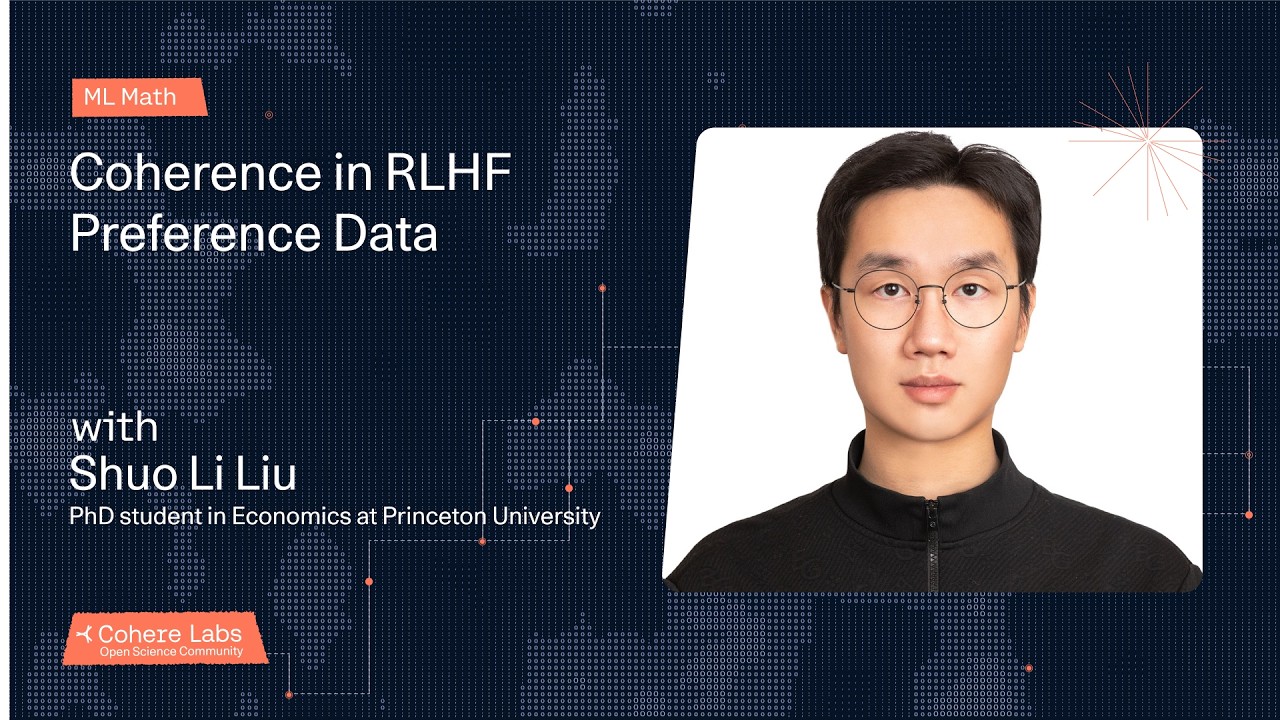
Shuo Li Liu - Coherence in RLHF Preference Data
Cohere
24 Apr 2026 24 apr. 2026

Shuo Li Liu - Coherence in RLHF Preference Data Shuo Li Liu - Coherence in RLHF Preference Data

RLHF usually learn from pairwise comparisons, often through Bradley-Terry-style models. I will discuss what coherence requirements, such as Weak Stochastic Transitivity and the Weak Axiom of Revealed Preference, mean for preference trained... RLHF usually learn from pairwise comparisons, often through Bradley-Terry-style models. I will discuss what coherence requirements, such as Weak Stochastic Transitivity and the Weak Axiom of Revealed Preference, mean for preference trained...

Open video → Open video →
Jiafei Duan  - Building Robotics Foundation Model with Reasoning in the loop
Cohere
24 Apr 2026 24 apr. 2026

Jiafei Duan - Building Robotics Foundation Model with Reasoning in the loop Jiafei Duan - Building Robotics Foundation Model with Reasoning in the loop

Scaling alone won’t unlock general-purpose robotics. Integrating reasoning directly into robot learning (spatial, temporal, and failure-based) so robots can learn more from limited data and continuously self-improve is the path forward. Ji... Scaling alone won’t unlock general-purpose robotics. Integrating reasoning directly into robot learning (spatial, temporal, and failure-based) so robots can learn more from limited data and continuously self-improve is the path forward. Ji...

Open video → Open video →
Aashish Rai  - Video Native Representations for 4D Gaussian Scenes
Cohere
20 Apr 2026 20 apr. 2026

Aashish Rai - Video Native Representations for 4D Gaussian Scenes Aashish Rai - Video Native Representations for 4D Gaussian Scenes

Volumetric videos offer immersive 4D experiences, but remain difficult to reconstruct, store, and stream at scale. Existing Gaussian Splatting based methods achieve high-quality reconstruction but break down on long sequences, temporal inco... Volumetric videos offer immersive 4D experiences, but remain difficult to reconstruct, store, and stream at scale. Existing Gaussian Splatting based methods achieve high-quality reconstruction but break down on long sequences, temporal inco...

Open video → Open video →
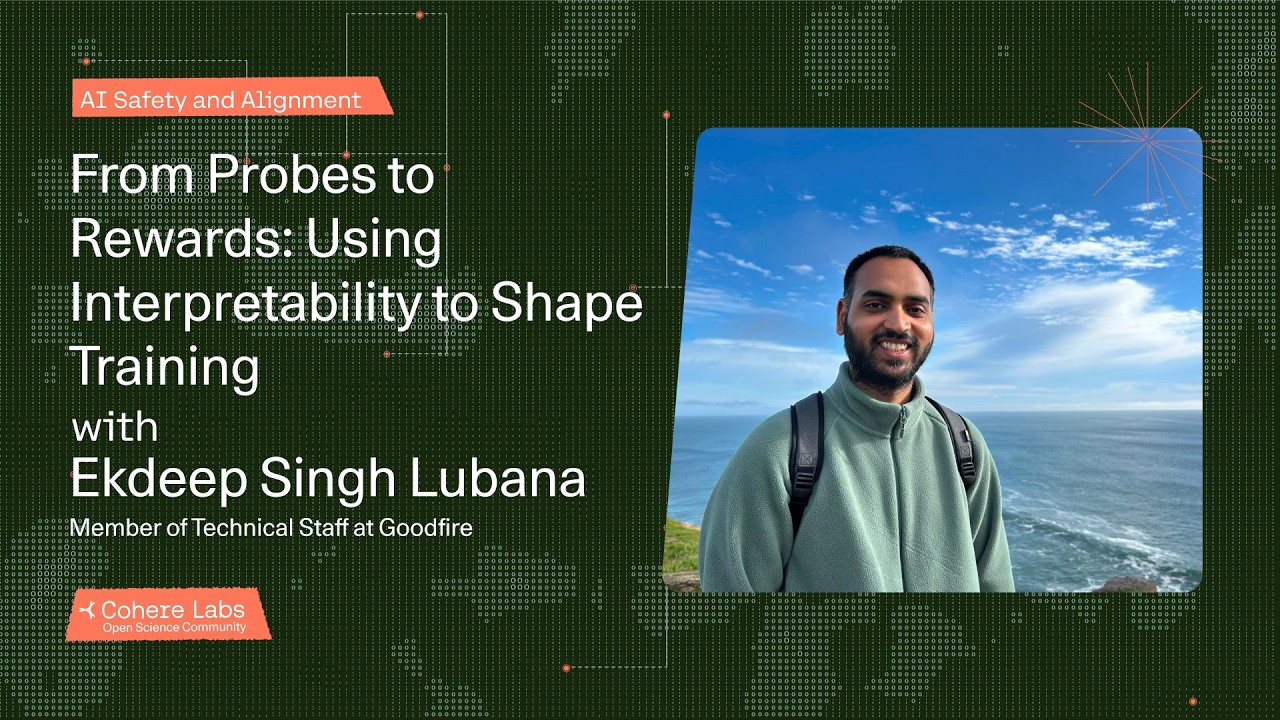
Ekdeep Singh Lubana - From Probes to Rewards  Using Interpretability to Shape Training
Cohere
20 Apr 2026 20 apr. 2026

Ekdeep Singh Lubana - From Probes to Rewards Using Interpretability to Shape Training Ekdeep Singh Lubana - From Probes to Rewards Using Interpretability to Shape Training

Ekdeep Singh Lubana — Guest Speaker @ Cohere Labs AI Safety & Alignment Reading Group Ekdeep is MTS at Goodfire, previously research fellow at Harvard's Center for Brain Science. His recent work addresses some core issues with how we extra... Ekdeep Singh Lubana — Guest Speaker @ Cohere Labs AI Safety & Alignment Reading Group Ekdeep is MTS at Goodfire, previously research fellow at Harvard's Center for Brain Science. His recent work addresses some core issues with how we extra...

Open video → Open video →

Gemini komt eraan